
According to recent industry reports, over 68% of small and medium businesses that partnered with professional software houses reduced their time to market by 35 to 45% compared to building in-house development teams. If you are struggling with delayed product launches, increasing development costs, or difficulty finding specialized tech talent, you are facing the same challenge we see across hundreds of client engagements.
A software house is not just a vendor but a strategic partner that handles everything from initial concept validation to full stack development, deployment, and ongoing maintenance. In this guide, we will walk through exactly how software house services work, what you should expect in 2026, and why companies increasingly turn to software companies in Pakistan for high quality and cost effective solutions. You will leave with a clear framework for evaluating providers and understanding return on investment.
What Is a Software House and How Does It Differ from Freelancers or In-House Teams
A software house also called a software development company or digital agency is an organization that provides end to end technology services under one roof. Unlike hiring individual freelancers or building an in-house team, you get access to cross functional expertise including developers, designers, quality assurance engineers, project managers, and sometimes marketing specialists all coordinated within a single engagement.
The Key Differences
Freelancers offer flexibility and lower upfront costs, but you manage coordination, quality assurance, and knowledge transfer yourself. We have seen projects stall when a solo freelancer gets sick or leaves mid sprint with no handover documentation.
In-house teams give you maximum control and cultural alignment, but hiring, onboarding, and retaining specialized talent especially in competitive markets costs significantly more. Our clients typically report 40 to 60% cost savings compared to full time salaries in expensive markets like Silicon Valley or New York.
Software houses sit in the middle. You get dedicated team accountability without the overhead of employment taxes, benefits, office space, or recruitment cycles. The agency absorbs project risk and continuity. If one developer leaves, the software house backfills immediately without disrupting your timeline.
Core Software House Services That Drive Business Growth
When evaluating software house services, look beyond simple app building. The best partners offer strategic depth across the entire product development lifecycle.
Custom Software Development
This is the foundation. Building bespoke applications tailored to your business logic, workflows, and competitive needs. Whether it is an internal ERP system, a customer facing SaaS platform, or an industry specific tool, custom development means zero compromises with off the shelf limitations.
In our experience, clients who invest in custom software see measurable improvements in operational efficiency. We have helped businesses automate manual processes that previously required 10 plus hours per week of administrative work.

Mobile App Development Services
Native iOS and Android apps, cross platform solutions using React Native or Flutter, or progressive web apps. Mobile app development is no longer optional for consumer facing businesses. It is the primary channel for engagement, retention, and revenue generation.
We prioritize frameworks that balance performance with speed to market. Flutter for instance allows us to ship both iOS and Android from a single codebase, cutting development time roughly in half compared to separate native builds.
UI and UX Design
A software house worth hiring will design before coding. User research, wireframing, prototyping, usability testing are not luxuries. Poor user experience is the number one reason users abandon apps within the first session.
We conduct heuristic evaluations and A/B test key flows like onboarding, checkout, and form submissions to ensure design decisions are data driven, not just aesthetic preferences.
Quality Assurance and Testing
Manual testing, automated regression suites, performance and load testing, security audits. Quality assurance catches bugs before your users do and it protects your brand reputation.
Automated testing is especially critical for enterprise software solutions with complex workflows. We use tools like Selenium, Cypress, and Postman to validate APIs and user journeys continuously throughout development.
IT Consulting and Technology Stack Selection
Choosing the wrong tech stack locks you into expensive rewrites down the road. A good software company in Pakistan or anywhere will recommend frameworks, databases, hosting environments, and third party integrations based on your scalability, budget, and time to market constraints, not just what the team prefers to code in.
We have migrated clients off monolithic architectures onto microservices using Docker and Kubernetes when they needed elastic scaling. We have also talked clients out of over engineering when a simpler Laravel or Django monolith would serve them for the next three years.
Staff Augmentation
Sometimes you have an internal team but need specialized skills like a machine learning engineer, a DevOps expert, or a mobile developer for three to six months. Staff augmentation embeds our professionals into your workflows, reporting directly to your project manager while we handle payroll and human resources.
This model works especially well for product development lifecycle phases like MVP launch sprints or major feature releases.
Ongoing Maintenance and Support
Launching is only 20% of the journey. Server patches, operating system updates, third party API changes, user reported bugs all require continuous attention. Many software houses offer retainer based support with service level agreement guarantees like response within four hours for critical issues.
We typically recommend reserving 15 to 20% of the original development budget annually for maintenance and iterative improvements.
Why Pakistan Has Become a Global Hub for Software Development
Pakistan’s software development industry has grown exponentially over the past decade and the reasons go beyond cost savings alone.
Competitive Pricing Without Compromising Quality
Hourly rates for senior developers in Pakistan range from 25 to 50 dollars compared to 100 to 200 dollars plus in North America or Western Europe. But here is what clients often miss. Cost effectiveness is not just about wages. It is about project velocity and scope delivered per dollar spent.
In our engagements, clients frequently get 30 to 40% more features within the same budget because overhead costs like office rent, benefits, and equipment are significantly lower and we pass those savings directly to project scope.
English Proficiency and Time Zone Flexibility
Pakistan is a former Commonwealth country with widespread English fluency especially in the tech sector. Communication barriers that are a common pain point with some Eastern European or Asian outsourcing destinations are minimal here.
Additionally, Pakistan Standard Time which is UTC plus 5 overlaps partially with European mornings and allows for scheduled calls with United States East Coast teams in the evening. We have structured sprint reviews and daily standups to accommodate clients from London, Dubai, New York, and San Francisco without anyone needing to join at 2 AM.
A Growing Talent Pool with Modern Tech Stacks
Pakistan graduates over 25,000 IT professionals annually, many trained in internationally recognized curriculums and certifications including AWS, Google Cloud, and Microsoft Azure. Universities and bootcamps emphasize practical industry aligned skills like React, Node.js, Python, Swift, and Kotlin rather than purely theoretical computer science.
We regularly hire mid level developers who have already shipped production apps or contributed to open source projects, meaning onboarding time is measured in days not months.
Government and Ecosystem Support
The Pakistan Software Export Board and initiatives like the National Incubation Centers provide grants, tax incentives, and infrastructure to tech startups and software houses. This ecosystem maturity translates to better project management practices, legal contract frameworks, and intellectual property protection mechanisms than you might expect.
How to Calculate ROI When Hiring a Software House
Return on investment from software house services is not always immediate revenue. It is also time saved, risk mitigated, and opportunities unlocked.
Direct Cost Savings
Compare the fully loaded cost of hiring in-house including salary plus benefits plus taxes plus recruitment fees plus equipment plus office space against the project based or retainer fee from a software house.
For example, hiring a full stack developer in San Francisco at 140,000 dollars per year plus 30% benefits equals roughly 182,000 dollars. A software house delivering equivalent output might charge 60,000 to 80,000 dollars annually for a dedicated developer, plus you avoid recruitment risk and turnover costs.
Time to Market Acceleration
Every month delayed is revenue lost and competitor advantage gained. A professional software company in Pakistan can mobilize a team within one to two weeks, whereas hiring and onboarding an in-house team often takes three to six months.
We helped a fintech client go from concept to beta launch in 14 weeks using an agile development methodology. Their internal estimate for the same scope with in-house hiring was nine plus months.
Opportunity Cost and Strategic Focus
Your internal leadership should not spend 20 hours per week managing developers, debugging deployment issues, or negotiating with cloud providers. Outsourcing frees your team to focus on core business activities like customer acquisition, partnerships, and fundraising.
One e-commerce client quantified this. Their chief marketing officer reclaimed roughly 15 hours per week previously spent troubleshooting site bugs, redirecting that time to campaigns that increased traffic by 35% quarter over quarter.
Risk Mitigation
Failed projects cost more than wasted budgets. They damage credibility with investors, customers, and internal stakeholders. Software houses absorb technical risk. If a framework does not scale, if an API gets deprecated, if security vulnerabilities emerge, the agency is contractually obligated to resolve them.
The End to End Process Working with a Software House
Understanding the workflow helps set realistic expectations and identify red flags early.
Discovery and Requirements Gathering
We start with stakeholder interviews, user persona mapping, and competitive analysis. The deliverable is a product requirements document or technical specification detailing features, user stories, acceptance criteria, and assumptions.
Any software house that skips this phase and jumps straight to coding is setting you up for scope creep and miscommunication.
Design and Prototyping
Wireframes, high fidelity mockups, interactive prototypes usually in Figma or Adobe XD. We validate designs with a subset of target users before writing a single line of code.
Insist on clickable prototypes. Static PDFs do not reveal navigation flow issues or mobile responsiveness problems.
Development Sprints
Using agile development methodology typically two week sprints, the team builds, tests, and demos incremental progress. You get a working build at the end of each sprint, not after six months of black box development.
Communication cadence we recommend includes daily standups that can be async via Slack or Teams for distributed teams, sprint demos every two weeks, and retrospectives to course correct.
Quality Assurance and User Acceptance Testing
Quality assurance runs parallel to development, testing each feature as it is completed, plus a dedicated user acceptance testing phase before launch. We create test cases mapped to every user story and run regression suites to ensure new features do not break existing functionality.
Deployment and Go Live
Server provisioning, DNS configuration, SSL certificates, app store submissions for mobile, monitoring setup using New Relic, Sentry, or Google Analytics. We script deployments using continuous integration and continuous deployment pipelines like GitHub Actions, GitLab CI, or Jenkins to minimize human error.
Post launch we monitor 24/7 for the first 72 hours with a war room Slack channel for immediate issue escalation.
Maintenance and Iteration
Retainer based support for bug fixes, operating system updates, and feature enhancements. Most clients move to a monthly retainer of 20 to 40 hours after launch, scaling up when planning major releases.
Common Mistakes Businesses Make When Choosing a Software House
We have onboarded clients who had painful experiences with previous vendors. Here is what went wrong and how to avoid it.
Choosing Based on Price Alone
The lowest bid often reflects corner cutting like junior developers, no quality assurance, no documentation, and no post launch support. You will pay two to three times the savings in bug fixes and rewrites.
Better approach is to evaluate on value delivered per dollar. Review portfolios, talk to references, and assess communication quality during the sales process.
Skipping the Contract Details
Vague statements like we will build your app lead to disputes. Your contract must specify scope and deliverables including features, platforms, and integrations, timeline and milestones, payment terms like upfront deposit, milestone based, or retainer, intellectual property ownership meaning you own the code and designs, change request process explaining how scope changes are priced and approved, and post launch support terms.
We provide itemized proposals down to individual features such as user authentication via OAuth equals 16 hours at a specific cost.
Ignoring Cultural and Communication Fit
Technical skills matter but so does responsiveness, transparency, and proactive problem solving. A software company in Pakistan with excellent English skills and structured communication including daily updates and sprint reports will outperform a cheaper less communicative vendor.
During vetting, test their communication. Do they ask clarifying questions? Do they respond within 24 hours? Do they admit when they do not know something?
No Clear Success Metrics
How will you know if the project succeeded? Define key performance indicators upfront like user adoption rate, page load speed, conversion funnel completion, and bug density.
We build analytics dashboards into every project so clients can track performance against goals in real time.
Underestimating the Importance of Design
We will fix the UI later is a trap. Users judge quality within seconds and poor design kills adoption regardless of backend robustness.
Allocate 20 to 25% of the project budget to UI and UX design and user testing. It is the highest return on investment you will make.
Read more about how to choose the software house in lahore
Key Technologies and Expertise to Look for in 2026
Technology changes fast. Here is what a forward looking software house should be proficient in this year.
Frontend Frameworks
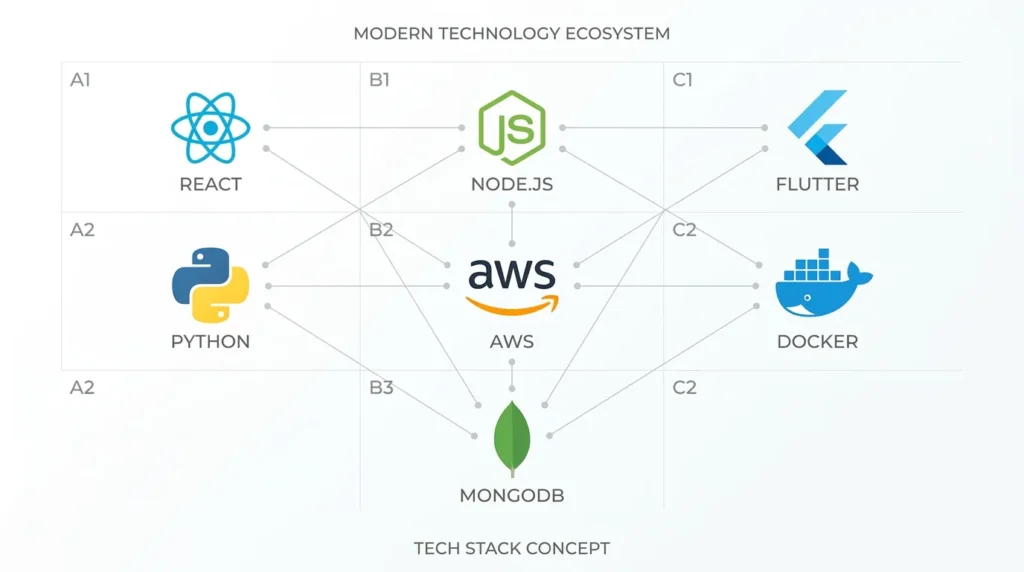
React and Next.js for dynamic web apps and SEO friendly server side rendering. Vue.js and Nuxt.js are lightweight and great for progressive web apps. Flutter offers cross platform mobile with near native performance. React Native has a mature ecosystem and large talent pool.
We recommend React plus Next.js for most web projects due to its ecosystem maturity, server side rendering capabilities, and strong community support.
Backend and APIs
Node.js and Express provide JavaScript everywhere with fast prototyping. Python with Django or Flask works well for data heavy apps and AI or machine learning integration. PHP and Laravel are cost effective and excellent for CRUD apps and content management systems. Microservices architectures using Docker and Kubernetes enable scalability.
For enterprise software solutions, we often architect RESTful or GraphQL APIs with microservices patterns, allowing independent scaling of authentication, payments, and notifications.
Databases
PostgreSQL is relational, ACID compliant, and open source. MongoDB is NoSQL with flexible schemas for rapidly evolving products. Redis handles caching and session management. Firebase and Supabase provide real time features and rapid prototyping.
Cloud and DevOps
AWS, Google Cloud, and Azure offer managed services that reduce operations overhead. Continuous integration and continuous deployment pipelines enable automated testing and deployment. Infrastructure as Code using Terraform or CloudFormation streamlines environment management.
We default to AWS for most projects due to breadth of services but recommend Google Cloud when heavy data analytics using BigQuery or Firebase integration is needed.
AI and Machine Learning and Emerging Tech
OpenAI API and GPT integration for chatbots and content generation. TensorFlow and PyTorch for custom machine learning models. Computer vision for image recognition and optical character recognition.
Clients increasingly request AI features like recommendation engines, predictive analytics, and automated customer support. A capable software house should either have in-house machine learning expertise or trusted partners.
Security and Compliance
OWASP Top 10 mitigation addressing SQL injection, XSS, and CSRF. GDPR, CCPA, and HIPAA compliance including data encryption, audit logs, and consent management. Penetration testing and vulnerability scanning using tools like OWASP ZAP and Burp Suite.
We run security audits before every production launch and quarterly for active projects.
Real World Example How Software House Services Accelerated a SaaS Launch
Consider a United States based HR tech startup aiming to disrupt onboarding automation. The founding team had domain expertise but no technical co-founder. They had 150,000 dollars in seed funding and nine months to launch a beta, onboard 50 pilot customers, and raise a Series A.
Discovery Phase
We conducted interviews with 12 HR managers who represented their target persona, mapped the onboarding workflow, and identified pain points including fragmented tools, manual data entry, and poor mobile experience.
The deliverable was a prioritized feature backlog and clickable Figma prototype validated with five potential customers. This phase took three weeks.
MVP Development
We built a React plus Next.js web app for the admin dashboard, a React Native mobile app for employee facing onboarding, Node.js microservices for user authentication, document management, and notifications, plus integrations with Slack, Google Workspace, and DocuSign.
The tech stack rationale was Next.js for SEO because their marketing site doubled as the app landing page, React Native to target both iOS and Android within budget, and Node.js for developer velocity using the same language across frontend and backend. This phase took 14 weeks.
Testing and Iteration
We ran usability tests with 10 HR admins, uncovering navigation confusion in the onboarding flow. We redesigned two screens and simplified the document upload process.
Automated testing covered 85% of code paths, catching regressions before they reached staging. This phase took four weeks.
Launch and Support
Beta launched on schedule. Within 60 days, they onboarded 53 pilot customers. App store ratings averaged 4.6 out of 5. One critical bug involving push notifications failing on Android 13 was identified and patched within eight hours thanks to our monitoring alerts.
The client raised a 2 million dollar Series A four months post launch, citing the polished product and early traction as key factors. Total investment with our software house was 110,000 dollars, leaving 40,000 dollars for marketing and operations from their original 150,000 dollar budget.
Attempting this in-house would have required hiring at least four full time engineers at 400,000 dollars plus annually, plus six to nine months recruitment and onboarding time, making the funding runway impossible.
How to Vet a Software Company in Pakistan
Not all software houses are equal. Use this checklist to separate professionals from pretenders.
Portfolio and Case Studies
Ask for three to five projects similar in scope and industry. Review live apps, not only screenshots. Check performance including page load speeds and mobile responsiveness, design quality like intuitive navigation and visual polish, and complexity such as handling real world edge cases like payment failures, offline mode, and multi language support.
Generic portfolio with stock photos and no verifiable links is a red flag.
Client References
Request contact info for two to three recent clients. Ask them did the project launch on time and within budget, how did they handle unexpected challenges or scope changes, and would you hire them again.
We proactively provide references because we are confident in our track record. Hesitation to share references is a warning sign.
Technical Competency Audit
Conduct a brief technical interview. Ask how do you ensure code quality expecting answers like code reviews, linting, and testing frameworks. Ask how do you handle security expecting OWASP compliance, encryption, and secure APIs. Ask to describe your deployment process expecting continuous integration and deployment, staging environments, and rollback procedures.
You do not need to be technical yourself. Just listen for specificity. Vague answers like we follow best practices suggest shallow expertise.
Communication and Project Management Tools
Ask what tools they use. Project tracking options include Jira, Trello, Asana, or Monday. Communication tools include Slack, Microsoft Teams, or Zoom. Version control includes GitHub, GitLab, or Bitbucket. Documentation includes Confluence, Notion, or Google Docs.
We give clients direct access to Jira boards and GitHub repos so they can monitor progress in real time.
Contract Terms and IP Ownership
Ensure the contract explicitly transfers all intellectual property including code, designs, and documentation to you upon final payment. Some vendors retain IP or charge extra for source code which is unacceptable.
Also verify confidentiality clauses like NDAs and data handling policies especially for GDPR or HIPAA sensitive projects.
Cultural Fit and Responsiveness
During the sales process, note response time to see if they reply within 24 hours. Look for proactive questions to see if they challenge assumptions or just say yes to everything. Assess transparency to see if they admit limitations or only promise the moon.
The sales experience predicts the project experience. If communication is slow or vague now, it will not improve under deadline pressure.
When to Choose Staff Augmentation vs Full Project Outsourcing
Both models leverage software house services but they fit different scenarios.
Staff Augmentation for Embedded Expertise
This works best when you have an internal team and project manager but lack specific skills such as an iOS developer, DevOps engineer, or quality assurance automation specialist. It suits short to medium term needs of three to twelve months. You want day to day control over tasks and priorities.
We assign dedicated professionals who integrate into your Slack channels, attend your standups, and use your project management tools. They report to your project manager or chief technology officer and we handle payroll, benefits, and backfill if someone leaves.
Pricing is typically hourly or monthly retainer per person.
For example, a SaaS company needed to add real time collaboration features similar to Google Docs style multiplayer editing. They had a solid backend team but no WebSocket or real time expertise. We embedded a senior Node.js engineer for six months to build the feature then transitioned knowledge to their internal team.
Full Project Outsourcing for Turnkey Delivery
This works best when you have a defined project scope like an MVP, mobile app, or redesign but no internal development team. You want the vendor to manage the entire delivery including design, development, quality assurance, and deployment. Fixed price or milestone based budgets are preferred.
We own the entire product development lifecycle. You provide requirements and feedback and we handle execution. You get a working product at the end with documentation and training.
Pricing is fixed price per project or milestone based such as 30% upfront, 40% at beta, and 30% at launch.
For example, an e-commerce brand wanted a custom mobile app for iOS plus Android for loyalty rewards and push notifications. They had no tech team and no desire to build one. We delivered the full project in 18 weeks including app store submission and post launch support.
Hybrid Model with Dedicated Teams
A middle ground involves assembling a cross functional team including project manager, developers, designer, and quality assurance dedicated exclusively to your project for six to twelve months. You get the accountability of outsourcing with the flexibility of augmentation.
Pricing is monthly retainer for the team.
This model works especially well for enterprise software solutions with evolving requirements. Think multi year roadmaps, not one off projects.
Frequently Asked Questions About Software House Services
What is the difference between a software house and a software company?
The terms are often used interchangeably. Software house is more common in Europe, the Middle East, and South Asia while software company or development agency is standard in North America. Both refer to organizations providing custom software development, design, quality assurance, and related IT services. The key differentiator from freelancers is the team based multi-disciplinary structure and formalized project management.
How much do software house services cost?
Pricing varies widely by geography, scope, and team seniority. In Pakistan, expect 25 to 50 dollars per hour for developers compared to 100 to 200 dollars plus in the United States or Western Europe. Fixed price projects such as a basic mobile app might range from 15,000 to 50,000 dollars for an MVP while enterprise solutions can exceed 200,000 dollars. Always request itemized proposals tied to specific deliverables and milestones to ensure transparency.
Why should I hire a software company in Pakistan?
Pakistan offers a unique combination of competitive pricing that is 30 to 60% lower than Western markets, strong English proficiency, a growing talent pool skilled in modern frameworks like React, Flutter, Node.js, and Python, plus favorable time zones for collaboration with Europe and North America. The software export industry is mature with established legal frameworks for intellectual property protection and data security making it a reliable nearshore and offshore option.
How long does it take to develop custom software?
An MVP typically takes 12 to 20 weeks from kickoff to launch depending on complexity. Simple mobile apps with three to five screens and basic CRUD can be ready in eight to ten weeks while enterprise software solutions with integrations, compliance requirements, and multi platform support may take six to twelve months. Timelines depend on scope clarity, client feedback speed, and change requests. Using agile development methodology, we deliver incremental working builds every two weeks so you see progress continuously.
What should I look for in a software house contract?
Key elements include detailed scope of work covering features, platforms, and deliverables, timeline and milestones, payment terms such as deposit, milestone based, or retainer, intellectual property ownership meaning you must own all code and designs upon final payment, confidentiality and NDA clauses, acceptance criteria explaining how you will verify deliverables, change request process describing how additional features are priced, and post launch support terms including warranty period, bug fixes, and maintenance service level agreements. Never sign a vague we will build your app contract.
Can a software house help with ongoing maintenance after launch?
Yes. Most software houses offer retainer based maintenance packages covering bug fixes, operating system and framework updates, security patches, performance monitoring, and minor feature enhancements. Typical retainers range from 10 to 40 hours per month depending on app complexity. This ensures your software stays secure, compatible with new devices and browsers, and optimized as user traffic grows. We recommend budgeting 15 to 20% of initial development costs annually for maintenance.
Conclusion
Software house services are no longer a nice to have for growing businesses. They are a strategic lever for speed, cost efficiency, and access to specialized expertise you cannot afford to hire full time. Whether you are launching a new product, scaling an existing platform, or modernizing legacy systems, partnering with the right software company in Pakistan or globally accelerates your roadmap while reducing financial and operational risk.
The key is choosing a partner who acts like an extension of your team with transparent communication, rigorous quality standards, and a track record of delivering real business outcomes, not just code.
At Websphere Hub, we have helped businesses across fintech, e-commerce, healthcare, and SaaS bring ideas to market faster and more cost effectively than in-house development or stitching together freelancers. Our full stack expertise spans web development, mobile app development, UI and UX design, SEO, and digital marketing and we operate with one goal which is turning your vision into a product that users love and investors notice.
Ready to accelerate your next project?
Contact Websphere Hub today for a free consultation and detailed project proposal. Let us build something exceptional together.
