
A founder we spoke with last year had already spent $40,000 with an agency in another country and still had nothing usable to show for it. By the time she came to us, she wasn’t asking “how much will this cost” anymore. She was asking “how do I make sure this doesn’t happen again.” That’s the real question behind most searches for mobile app development in Pakistan — and it’s the one most generic articles never answer.
This article explains what hiring a mobile app development company in Pakistan really looks like in 2026 — real cost ranges, where quality is strong and where it isn’t, how to check mobile app developers in Pakistan before you sign anything, and how the risks compare to other outsourcing hubs. No exaggerated claims, no “Pakistan is the best in the world” talk.
Why Businesses Are Looking at Pakistan for App Development
Pakistan has one of the largest English-speaking IT workforces in South Asia. The freelance and agency export sector has grown fast — Pakistani freelancers earned a record $1.76 billion in foreign exchange during fiscal year 2025-26, a 78% jump from the year before, according to State Bank of Pakistan data. Pakistan now ranks 16th out of 193 countries on the Global Outsourcing Talent Index, which looks at labor cost, English skills, talent availability, digital infrastructure, and stability. This growth didn’t happen just because clients were being kind. It happened because the cost-to-skill ratio is genuinely strong compared to India and the Philippines, and it’s getting closer to Eastern Europe too for mid-size projects.
In our experience working with clients in the Gulf, UK, and North America, people looking for mobile app developers in Pakistan usually fall into one of three groups:
- Startups building an MVP who need to move fast without spending their whole budget on development.
- Small and medium businesses going digital — a retail shop wanting an ordering app, a clinic wanting a booking app — where the app supports the business, it isn’t the whole business.
- Agencies and companies abroad sending extra work to a Pakistani team to save money.
Each type of buyer needs a slightly different approach to hiring, and we’ll cover that below. But the main reason Pakistan keeps showing up on shortlists is simple: similar technical work at a lower hourly rate, as long as you know how to find the teams that actually deliver.
What Mobile App Development in Pakistan Actually Costs
This is the number everyone really wants, so here it is straight — with the note that prices change by city, team experience, and whether you’re hiring a freelancer, a small agency, or a bigger mobile app development company.
Typical hourly rates (2025-2026 range):
- Junior/mid-level freelance developer: $8-15/hour
- Established boutique agency (5-30 person team): $18-35/hour
- Larger agency with proper QA and project management staff: $30-50/hour
Typical fixed-price project ranges:
- Simple MVP (one platform, 4-6 core screens, simple backend): $3,000-8,000
- Mid-size app (both platforms, custom backend, integrations like payments or maps): $10,000-30,000
- Complex app (real-time features, multiple user roles, custom infrastructure, built to scale): $35,000-100,000+
These numbers are usually much lower than US or UK agency pricing, and generally at or below India’s pricing, depending on the city and team. One mistake we see a lot: buyers pick the cheapest quote out of a batch without checking what’s actually left out of it. QA time, revision rounds, post-launch bug fixes, and app store submission are the things that quietly disappear from cheap quotes and come back later as extra charges.
A simple rule we use with clients: if a quote is more than 40% below the average of everything else you’ve received for the same scope document, ask what’s missing before you ask why it’s so cheap. Usually something is missing — it’s rarely just efficiency.
Quality: Where Pakistani Teams Excel and Where They Don’t
Saying “Pakistan has great developers” doesn’t really help you as a buyer. What helps is knowing where quality is usually strong and where it usually slips, so you can check for it yourself.
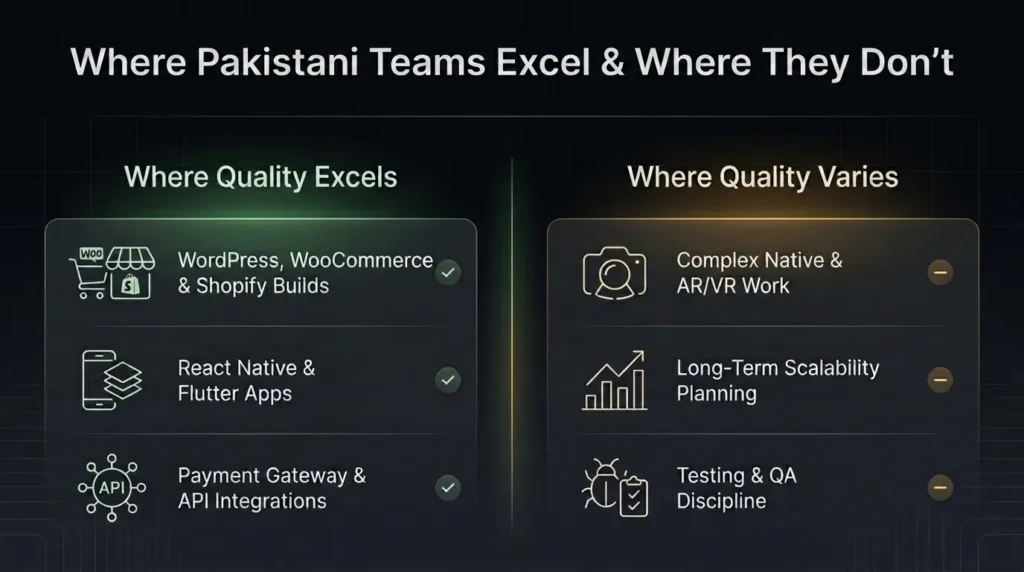
Where we’ve consistently seen strong work:
- WordPress/WooCommerce and Shopify-related builds, e-commerce integrations, and CMS-based apps — this is a very common specialty in the local market, so competition has pushed quality up.
- React Native and Flutter apps for standard business needs (booking, ordering, service marketplaces) — these frameworks are widely taught and widely used here.
- API integration work — payment gateways, SMS/OTP providers, logistics APIs — because so much local client work already needs connections to regional payment systems.
Where quality is more mixed:
- Complex native performance work (heavy AR/VR, advanced camera processing, custom native modules) — fewer teams have deep specialists here, so checking carefully matters more.
- Long-term planning for growth — we’ve taken over projects where the first version worked fine, but no one had thought about what happens once the user base grows 10x.
- Testing discipline — automated testing isn’t standard at smaller shops. Manual testing quality also varies a lot from team to team.
None of this is unique to Pakistan — you’d find the same variation checking agencies anywhere. The difference is that so many new agencies are entering this market that the gap between the best and worst teams is wider than in more established markets. That means checking carefully matters more here, not less.
How the Best App Development Companies in Pakistan Actually Work
The stronger app development companies we’ve worked with or competed against tend to follow a similar pattern. It’s worth knowing what “good” looks like before you compare proposals.
- They plan before they price. A firm that gives you a fixed price within a day of your first call, without a proper discovery call or written plan, is guessing — and that price will change once the real requirements come out.
- They treat design and development as separate steps, with wireframes and at least a basic clickable prototype before any code is written. Skipping this step is the single biggest cause of scope creep we’ve seen in other teams’ projects that we later got called in to fix.
- They work in sprints with clear check-ins, not a single “we’ll show you when it’s done” date. Even a simple two-week cycle with a demo at the end lets you catch problems early.
- They handle app store submission themselves, including Apple’s review rules (privacy details, tracking permissions, sign-in requirements) instead of leaving it as an afterthought that delays your launch by weeks.
One trust signal worth asking about directly: how many apps has this team actually published on the App Store or Play Store, compared to how many are still “in development” on their portfolio page. A portfolio full of design mockups with no live app links is a sign to look closer before you commit.
Native vs Cross-Platform: What Local Teams Typically Recommend
This choice often gets made too quickly on projects, but it has real cost effects — so it’s worth talking about directly instead of leaving it up to whichever framework a developer happens to prefer.
Cross-platform (Flutter, React Native) makes sense when:
- Your app uses standard features (lists, forms, feeds, maps, chat) and doesn’t need deep access to phone hardware.
- You need to launch on iOS and Android at the same time on a limited budget.
- You’ll need a smaller internal team to maintain the app after launch.
Native (Swift for iOS, Kotlin for Android) makes more sense when:
- You need top performance for something graphics-heavy or camera-heavy.
- You’re building deep platform-specific features (widgets, background processing, ARKit/ARCore) that cross-platform tools handle less well.
- You expect the two platforms to look and work quite differently over time.
In our experience, around 80% of business app requests don’t actually need native performance — a booking app, a service marketplace, an internal tool, a loyalty app. Cross-platform gets these to market faster and cheaper with no real downside. Where we push back on clients is when they ask for native just because it “sounds more premium,” with no real technical reason. That’s paying for an image, not a need — and a good agency should tell you that honestly instead of taking the bigger invoice.
Red Flags to Watch For Before You Sign a Contract
These aren’t guesses — they’re patterns we’ve seen directly, either from clients who came to us after a bad first experience, or from other teams’ work we’ve had to review and fix.

- No written scope before payment. If the agreement is just a verbal idea of “an app like Uber but for X,” don’t move forward until it’s written down with specific screens and features listed.
- Asking for 100% payment upfront. A normal setup is milestone-based — a deposit, a mid-project payment, and a final payment — not full payment before any work is done.
- Vague answers about who’s on the team. Ask for names, roles, and experience level — not just “our team of experienced developers.” Agencies handling too many clients sometimes staff your project with whoever is free that week.
- No clause on who owns the source code. Make sure it’s written down that you own the full codebase and design files after final payment, not just a hosted version you can’t move elsewhere.
- Timelines that seem too good to be true. A 6-8 week promise for a genuinely complex app with backend infrastructure, several integrations, and two platforms usually means the scope isn’t fully understood, or QA time is going to get cut to hit the date.
- No post-launch support terms. Apps run into problems once real users start using them in ways a test environment never showed. Confirm what’s covered in the first 30-90 days after launch before you sign — not after something breaks.
How to Vet a Mobile App Development Company in Pakistan
Beyond watching for the red flags above, here’s the process we’d actually recommend before you commit any budget.
- Ask for 2-3 live app links from their portfolio, not just screenshots. Install them, use them, read the store reviews.
- Ask for a reference client you can actually call, ideally in a similar industry or with a similar app complexity to yours.
- Run a small paid trial first if the full project is large. A two-week paid discovery or prototype phase tells you far more about how a team communicates and delivers than any sales call.
- Ask how they handle disagreement, not just agreement. Try asking directly: “tell me about a project where the client’s original idea wouldn’t have worked — what did you do?” A team that only ever says yes isn’t necessarily protecting your project.
- Confirm their actual tech stack matches your needs. Ask specifically what they use for the type of app you’re building, not a generic “we use the latest technologies” answer.
Communication, Time Zones, and Project Management Reality
This is a part buyers often underestimate until it becomes a daily headache. Pakistan’s working hours overlap fairly well with the Gulf region (about a 1-2 hour difference) and reasonably with UK morning hours, but overlap with US Pacific time is very small — often just an hour or two, depending on the city and team.
What actually works in practice:
- Written, async-first updates on a daily or twice-weekly basis, rather than depending on live calls as the main way to communicate.
- A shared project board (Trello, Jira, ClickUp — the tool matters less than whether it’s kept up to date) that you can check anytime without waiting for a status call.
- One or two scheduled overlap-hour calls per week for anything that really needs real-time discussion, instead of expecting instant replies at all hours.
We’ve seen projects with almost no timezone overlap go smoothly because the process was disciplined, and we’ve seen projects with good overlap still stall because updates weren’t consistent. The timezone gap is manageable. Inconsistent communication is the real risk.
Case Scenarios: Two Different Outcomes
Scenario A (hypothetical, based on common patterns): A UK-based logistics startup hires a Lahore-based team for a driver-tracking app after just one sales call and a verbal price — no written scope, full payment upfront. Six weeks in, the “finished” app has never been properly tested for GPS accuracy, and the backend can’t handle more than a handful of drivers at once. The founder ends up paying a second team to rebuild the backend from scratch — the total cost ends up higher than if they’d hired a pricier, better-checked team from the start.
Scenario B (hypothetical, based on common patterns): A Dubai-based clinic chain runs a two-week paid prototype phase with a Karachi-based agency before committing to the full build. They check two live reference apps from the agency’s past work, and lock in a milestone-based payment schedule with a written scope. The MVP launches nine weeks later, with a clear post-launch support window. Costs stayed close to the original estimate because the scope was locked early, and any new requests were priced separately instead of quietly absorbed.
The difference in outcome wasn’t about luck, or which city the team was in — it came down to process discipline on the buyer’s side, just as much as the vendor’s.
Pakistan vs Other Outsourcing Destinations
| Factor | Pakistan | India | Eastern Europe |
|---|---|---|---|
| Typical hourly rate | $8-50 | $10-60 | $30-80 |
| English proficiency | Generally strong | Generally strong | Variable, improving |
| Timezone overlap (US) | Low | Low-moderate | Moderate-high |
| Timezone overlap (UK/EU) | Moderate | Moderate | High |
| Market maturity/vendor count | Growing fast, wide quality spread | Very mature, saturated | Mature, narrower spread |
| Common specialty | WordPress/Shopify, cross-platform apps, cost-sensitive MVPs | Full-stack enterprise, large dev teams | Complex/native engineering, EU compliance work |
Pakistan tends to win on raw cost-to-output ratio for small-to-mid size apps, and falls a bit behind on how mature the vendor market is. That means the checking burden on you as a buyer is real, not optional. That’s not a knock on the market — it’s simply where it stands in its growth right now.
Frequently Asked Questions
Is mobile app development in Pakistan cheaper than in India?
Often about the same, sometimes a bit cheaper depending on the city and team, but the gap has narrowed. Rates in both countries cover a wide range depending on team experience and process quality, so comparing specific cities matters more than a general country-level comparison.
How long does it take to build a mobile app in Pakistan?
A simple MVP usually takes 6-10 weeks. A mid-size app with a custom backend and integrations usually takes 10-18 weeks. Timelines depend a lot on how clearly the scope is locked before development starts — unclear requirements are the biggest cause of delay, not the team’s skill.
Can I trust a mobile app development company in Pakistan with intellectual property?
Yes, as long as the contract clearly gives you IP and source code ownership after final payment, in writing, before work starts. This isn’t specific to Pakistan — it’s standard practice to confirm with any outsourced vendor anywhere in the world.
Do Pakistani app developers work with Flutter and React Native?
Yes. Cross-platform frameworks are widely used and taught here, and most established agencies suggest Flutter or React Native by default for standard business apps, saving fully native development for cases with a real technical reason for it.
What’s a realistic budget for a small business app built in Pakistan?
For a simple app with core booking, ordering, or catalog features on both platforms, a realistic range is $8,000-20,000, depending on backend complexity and third-party integrations. Anything much lower than that usually means less scope or less QA, not a genuine saving.
Is it better to hire a freelancer or an agency for app development in Pakistan?
Freelancers can work well for small, clearly defined projects with a client who’s comfortable managing the process. Agencies make more sense once you need proper QA, project management, and a team that can cover for someone leaving or getting sick without stalling your timeline — the bigger the app, the more that structure matters.
So, Is It Worth It?
Mobile app development in Pakistan is worth it for the right buyer with the right process — cost-effective, capable across common frameworks like Flutter and React Native, and a market that keeps maturing. It’s not automatically worth it if you skip scoping, skip reference checks, and pay everything upfront to the first team that replies. The businesses that get a good outcome are the ones who treat vendor selection just as seriously as they would anywhere else in the world — written scope, milestone payments, and a real look at live, shipped work before signing.
If you’re deciding whether to move forward, Websphere Hub‘s mobile app development team can walk you through a scoped proposal, a realistic timeline, and a fixed milestone structure before you commit any budget — reach out for a project consultation to get a written estimate for your specific app.
Want to go deeper? Read our Complete Guide to Android & Phone App Development for a full technical breakdown of the app-building process, from planning to launch.
